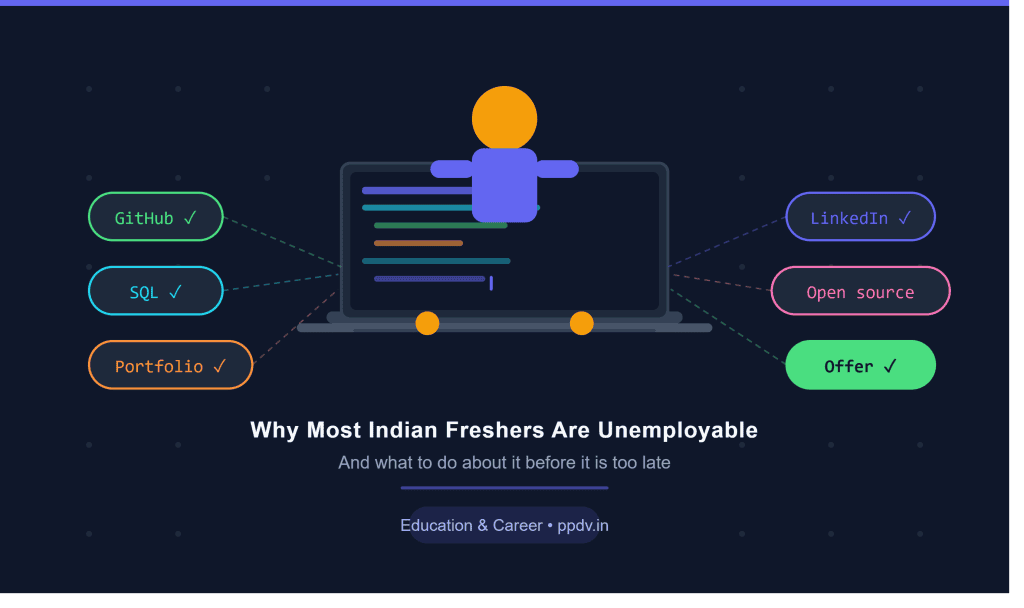
My neighbour’s son Rohit graduated with a B.Tech in Computer Science from a private engineering college in Greater Noida last June. He had a 7.4 CGPA. He had done one internship — two months at a small IT firm in Noida Sector 62 where he had mostly fixed bugs in legacy code and attended standup meetings. He had applied to 140 companies through campus placements and off-campus portals between January and May.
He received zero offers.
Not because he was unintelligent. Not because he had chosen the wrong field. Because there was a gap — specific, identifiable, and fixable — between what he had been taught to do and what every company interviewing him needed him to be able to do.
When I sat with him one evening in July and went through his preparation, the picture became clear within twenty minutes. He could not write a SQL query from scratch without referring to notes. He had never deployed a project to any cloud platform. His GitHub account had two repositories — one from a college assignment and one half-finished personal project he had abandoned six months earlier. He had never used Git in a team setting. He could not explain what an API was in plain English to a non-technical person. He had memorised the definitions of data structures but could not solve a simple array problem on a whiteboard without significant prompting.
None of this was his fault entirely. His college had taught him to pass exams. It had not taught him to work.
This article is about the gap between those two things — and what you can do in the next six months to close it, regardless of which college you attended or what your CGPA is.
The Scale of the Problem — and Why It Is Getting Worse in 2026
India produces approximately 1.5 million engineering graduates per year. A 2024 report by Aspiring Minds — one of the most widely cited employability research organisations in India — found that fewer than 4 percent of engineers from non-IIT, non-NIT colleges were employable for software development roles without significant additional training. For non-engineering graduates the picture is similarly difficult — a large proportion of commerce, arts, and science graduates enter the job market without demonstrable skills that employers can verify.
This gap has widened significantly in the past two years for a reason that most career advice in India is not being honest about: AI tools have automated the entry-level tasks that used to give freshers a way to prove themselves on the job. The junior developer who used to spend six months writing basic CRUD applications now competes against AI tools that generate them in minutes. The junior content writer who used to build skills through volume now competes in a market where AI generates first drafts instantly.
What this means practically for Indian freshers in 2026 is that the tolerance for a slow ramp-up period — where a company hires you knowing you will need six months to become genuinely productive — has essentially disappeared at most organisations. The companies that are hiring freshers want someone who can contribute from week two, not month six.
The fresher who gets hired in this environment is the one who has already closed the gap before the interview. Not during the first job. Before it.
What Employers Are Actually Looking For — and Not Finding
When I spoke with Prashant — the head of engineering at a 60-person Bengaluru SaaS startup — earlier this year, I asked him directly what freshers were getting wrong in their interviews.
He said: “I interview maybe fifteen freshers a month. Twelve of them can tell me what a binary search tree is. Three of them can actually write the code to implement one without help. One of them has ever built something outside of college assignments — a side project, a freelance website, anything. That person gets the interview with my CTO.”
He paused and added something I have thought about since: “The CGPA is the last thing I look at. I look at the GitHub first. If the GitHub is empty or has only college submissions, I already know what the interview is going to tell me.”
Across conversations with hiring managers in Delhi, Bengaluru, and Hyderabad, the same themes emerged consistently:
Demonstrable skills beat theoretical knowledge every time. A fresher who has built a working project — even a simple one — that is visible online is immediately more credible than one who can only describe what they know in an interview.
Communication ability is evaluated from the first email. The way a candidate writes their application email, structures their resume, and speaks in the first two minutes of an interview communicates something about their thinking clarity that no certification can compensate for.
Curiosity is visible and valuable. Candidates who have clearly explored beyond their syllabus — who mention a podcast they found useful, a side project they started out of genuine interest, a problem they tried to solve on their own — stand out immediately from those who present their college curriculum as the sum total of their engagement with their field.
The ability to work with others is evaluated through examples. Open source contributions, college project team experiences described specifically, hackathon participation — anything that shows the candidate has worked with other people on a shared technical problem is taken seriously.
The Six Things Rohit Did in the Following Six Months
After our July conversation Rohit and I made a list. Not a vague resolution list — a specific, time-bound action list with one item for each of the six months between August and January.
Here is exactly what was on it and what happened:
August — One complete project on GitHub. Not a tutorial. Not a college assignment. An original project that solved a real problem he had — he built a simple expense tracker web app using Python and Flask because he was manually tracking his monthly expenses in a notebook and found it annoying. It took him the full month working three hours a day. By the end of August it was live on GitHub with a README explaining what it did, why he built it, and how to run it. His GitHub went from two abandoned repositories to one complete, documented, deployed project.
September — One SQL certification from a credible source. He completed the free SQL course on Mode Analytics and the HackerRank SQL certification — both free, both credible in a resume context, both genuinely skill-building rather than ceremonial. He practiced 150 SQL problems across HackerRank and LeetCode’s database section. By September’s end he could write complex joins, subqueries, and window functions without referring to notes.
October — LinkedIn profile rebuilt and active. He rewrote his LinkedIn headline from “B.Tech Computer Science | Seeking Opportunities” to “Python Developer | Built expense tracker app | SQL | Open to Entry-Level Roles.” He added his GitHub project to his Featured section. He wrote three LinkedIn posts during October — one about what he learned building the expense tracker, one about a SQL concept he had found confusing and how he finally understood it, one about a side project idea he was considering. Total post views: modest. But two hiring managers who later interviewed him mentioned they had read his posts before the interview.
November — Contribute to one open source project. This was the item on the list he was most resistant to. He felt his code was not good enough. I told him that was exactly the point — contributing to open source forces you to read other people’s code, understand a codebase you did not write, and communicate about code through pull request comments. He found a beginner-friendly Python project on GitHub through the “good first issue” tag, fixed one documentation bug, and submitted one small feature. Both were merged. Both are on his GitHub contribution graph.
December — Apply for five internships or junior roles every week, not five hundred random applications. In his first job search Rohit had applied to 140 companies with the same resume and the same generic cover letter. In December he applied to 22 companies total — each with a customised application that mentioned something specific about the company and connected his expense tracker project to a problem the company cared about. He received seven responses. In his previous search with 140 applications he had received two.
January — Interview preparation through doing, not memorising. He did 60 LeetCode problems in January — not to memorise solutions but to get comfortable with the process of thinking through a problem out loud, which he practised by recording himself on his phone and watching the playback. He did three mock interviews through Pramp (free peer-to-peer mock interview platform). He researched every company he had an interview scheduled with and prepared one specific question for each interviewer based on their LinkedIn profile.
In February, Rohit received two job offers. He accepted one — a junior backend developer role at a fintech startup in Noida Sector 132, salary ₹5.4 lakh per annum. The second offer was from a slightly larger company at ₹4.8 lakh which he declined.
The Specific Actions That Will Move Your Candidacy Forward Right Now
If you are reading this as a fresher or recent graduate who is struggling with a job search, here is the most honest prioritisation I can give you based on Rohit’s experience and the conversations I have had with people doing the hiring:
Build one real thing and put it on GitHub this month. Not a tutorial. Not a college project. Something you built because you wanted to solve a problem. The problem does not need to be impressive — an expense tracker, a recipe organiser, a to-do list with a twist. What matters is that you designed it, built it, documented it, and can talk about the decisions you made.
Fix your LinkedIn profile this week. Your headline is not your degree. It is what you can do and what you have built. Your Featured section should have your GitHub project. Your About section should have one paragraph that reads like a human being wrote it — what you are good at, what you have built, what kind of role you are looking for.
Practice writing code by hand or on a whiteboard. Not in an IDE with autocomplete. On paper or in a plain text editor. This is specifically what Rohit could not do in his first round of interviews and specifically what changed after his LeetCode preparation. You do not need to solve hard problems. You need to be comfortable solving easy problems without help.
Apply to fewer companies with more effort per application. The mathematics of 140 generic applications returning two responses is a clear signal. Twenty targeted applications to companies you have researched, with cover letters that mention something specific, returns a meaningfully better ratio. This is not a theory — it is what Rohit’s December demonstrated against his January to May comparison.
Talk to one person who is doing the job you want. LinkedIn makes this possible in a way that was not available to the generation before us. Send a connection request with a short genuine note — not asking for a job, asking for fifteen minutes to understand what the role actually involves day to day. Most people will not respond. Some will. One conversation with someone who is actually doing the job you want is worth more than twenty hours of generic interview preparation.
A Final Word
Rohit came over last week. He has been at the fintech startup for three months. He is working on a payments reconciliation feature with a senior developer who has been patient with his questions. He said the first two weeks were uncomfortable — the codebase was large and unfamiliar, the pace was faster than he expected, and there were moments where he felt out of his depth.
He also said he felt prepared in a way he had not felt during his first job search. Not because he knew everything. Because he had already been uncomfortable — in his GitHub project when the code broke in ways he did not understand, in the open source contribution when his pull request was returned with comments he had to research to address, in the mock interviews when he got stuck and had to think out loud about not knowing the answer.
The six months of preparation did not make him an expert. They made him someone who had already learned how to be a beginner in a professional context — which is exactly what a first job requires.
Start this month. Build one thing. Put it somewhere people can see it. The rest follows.
Alen is a Delhi-based writer covering career development, personal finance, and health topics for Indian audiences since 2020. He has helped multiple people in his personal network navigate their first job searches and draws on those conversations — particularly Rohit’s — for everything he writes about early careers in India.

Alen is a Delhi-based writer covering personal finance, health, and career topics for Indian audiences. He has been writing about practical financial and lifestyle topics since 2020 and believes that clear, honest information should be accessible to every Indian regardless of background
Leave a Reply