
Maths Strategy for Non-Maths Background Students: How to Score 40+ in SSC CGL
If you are an Arts, Commerce, or Biology student, the “Quantitative Aptitude” (Maths) section of the SSC CGL syllabus probably gives you nightmares.
You might be thinking: “I haven’t touched Maths since Class 10. How can I compete with B.Tech engineers?”
Here is the good news: SSC CGL Maths is not about being a genius. It is about pattern recognition.
You do not need to solve every question to get a government job. You just need to clear the cutoff and maximize your score in the easy chapters. This guide is your “Survival Strategy” to score 40+ marks (out of 50) in Tier-1, even without a strong Maths background.
The Golden Rule: Arithmetic is Your Best Friend
The SSC syllabus is divided into two parts: Arithmetic and Advanced Maths.
For a non-maths student, Arithmetic is the key. It relies on logic and calculation, not complex formulas.
-
Arithmetic Topics: Percentage, Profit & Loss, Ratio, Time & Work.1
-
Advanced Topics: Geometry, Trigonometry, Algebra.2
Strategy: Focus 70% of your energy on Arithmetic. If you master Arithmetic, you secure nearly half the marks immediately.
The “Easiest First” Study Order
Do not start with Geometry. You will get frustrated and quit. Follow this strict order to build confidence:
| Order | Chapter Name | Difficulty Level | Why Start Here? |
| 1 | Percentage | Very Easy | It is the base of 5 other chapters. |
| 2 | Ratio & Proportion | Easy | Teaches you how to shorten calculations. |
| 3 | Average | Easy | Simple formula-based questions. |
| 4 | Time & Work | Moderate | Highly repetitive question patterns. |
| 5 | Profit & Loss | Moderate | High weightage in exams. |
How to Tackle “Advanced Maths” (Without Crying)
You cannot skip Advanced Maths completely, but you can study it smartly.
Instead of trying to prove theorems, focus on Formula-Based Direct Questions.
-
Mensuration (2D/3D): Just memorize the formulas for Volume and Surface Area (Cylinder, Cone, Sphere). Direct formula questions appear in every shift.
-
Algebra: Focus on standard identities (like $x + 1/x$). You don’t need to learn complex polynomial theory.
-
Trigonometry: Learn the “Value Putting Method” (putting $\theta = 0, 30, 45$). This solves 50% of trigonometry questions without actual solving.
The 3-Step “Non-Maths” Routine
Step 1: Concept Video (YouTube)
Don’t read books first. Watch a teacher explain it. Search for “Percentage for Weak Students” on YouTube.
-
Recommended: Aditya Ranjan Sir or Rakesh Yadav Sir (start with their basic videos).
Step 2: Previous Year Questions (PYQ)
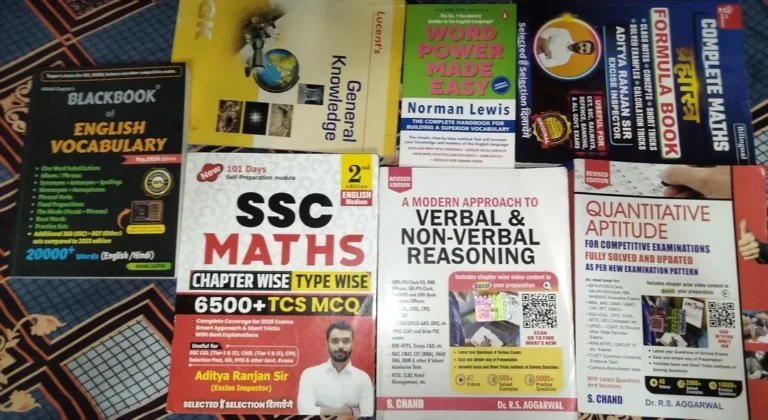
SSC repeats questions. Buy a “PYQ Book” (like Kiran or Pinnacle) and solve only the “Type 1” and “Type 2” (easy) questions first.
-
Tip: If a question takes more than 3 minutes, skip it. You are learning to pass, not to be a professor.
Step 3: Calculation Drill (15 Mins Daily)
Your biggest enemy is calculation speed. Download a “Maths Workout” app and practice:
-
Multiplication tables (up to 20)
-
Square roots (up to 30)
-
Cube roots (up to 15)
Common Mistakes to Avoid
-
Comparing yourself to others: Don’t look at the engineers solving questions in 10 seconds. Focus on your accuracy.
-
Ignoring the basics: Do not jump to “Short Tricks” until you understand the basic concept. Tricks vanish under exam pressure; concepts stay.
Conclusion
Being weak in Maths is not a permanent disability. It is just a lack of practice.
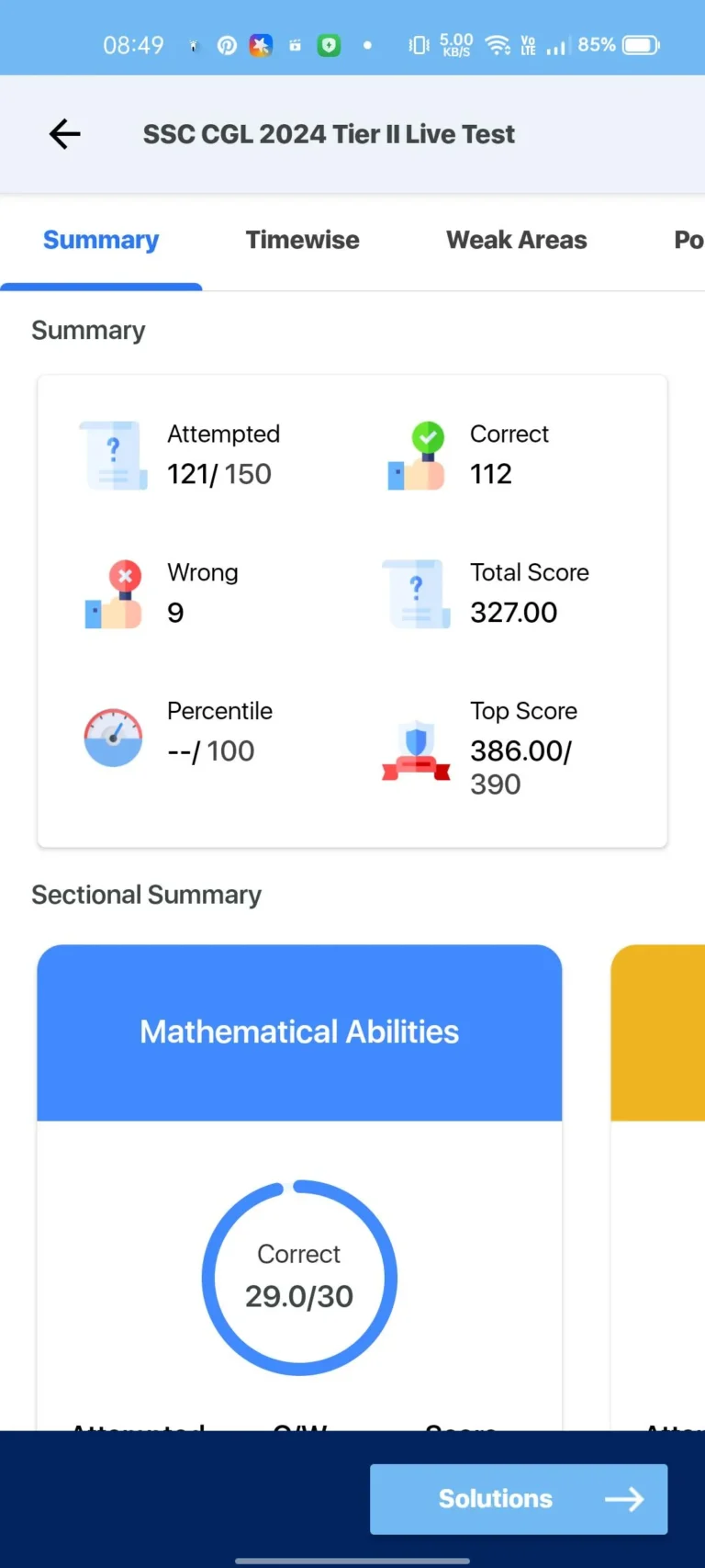
Start with Percentage today. Solve 50 questions. Once you see those green ticks on your mock test, your fear will vanish.
Need a time management plan to fit this into your day? Check out our guide on How to Prepare for SSC CGL While Doing a Full-Time Job.