How to Make Short Notes for Government Exams: The “Vertical Fold” Method
If I looked at your study table right now, would I find a notebook that looks exactly like your textbook?
Most aspirants make a fatal mistake: They mistake “Copying” for “Note Making.”
You read a line in the book, and you write it in your copy. You feel productive, but you are actually wasting time. If you are just rewriting the book, why did you buy the book in the first place?
Effective notes are not “Summaries.” Effective notes are “Triggers.” They should trigger your brain to recall the full concept.
Today, I am sharing the “Vertical Fold Method”—a scientific way to make notes that force you to actually learn, not just write.
The Golden Rule: Never Make Notes on First Reading
This is where 90% of students fail.
When you read a chapter for the first time, everything looks important. If you make notes now, you will copy the whole chapter.
The Strategy:
-
Read 1: Just read the chapter (Novel style). Understand the story.
-
Read 2: Highlight key dates and formulas.
-
Read 3: Now, open your notebook. You will realize that 60% of the chapter was fluff, and only 40% is worth writing down.
The “Vertical Fold” Method (Active Recall)
Stop writing in long paragraphs. Use this layout to turn your notebook into a testing machine.
Step 1: Take an A4 sheet or notebook page.
Step 2: Fold it vertically in half (or draw a line down the middle).
Step 3:
-
Left Column: Write the Keyword or Question.
-
Right Column: Write the Answer or Formula.
How to Use It:
When you revise, cover the Right Column with your hand. Look at the “Keyword” on the left and force your brain to recall the answer.
-
If you recall it: Great. Move on.
-
If you fail: Check the right side and mark a Red Star on the left.
This is called Active Recall. It is 10x more effective than passively reading paragraphs.
Subject-Wise Note Strategy
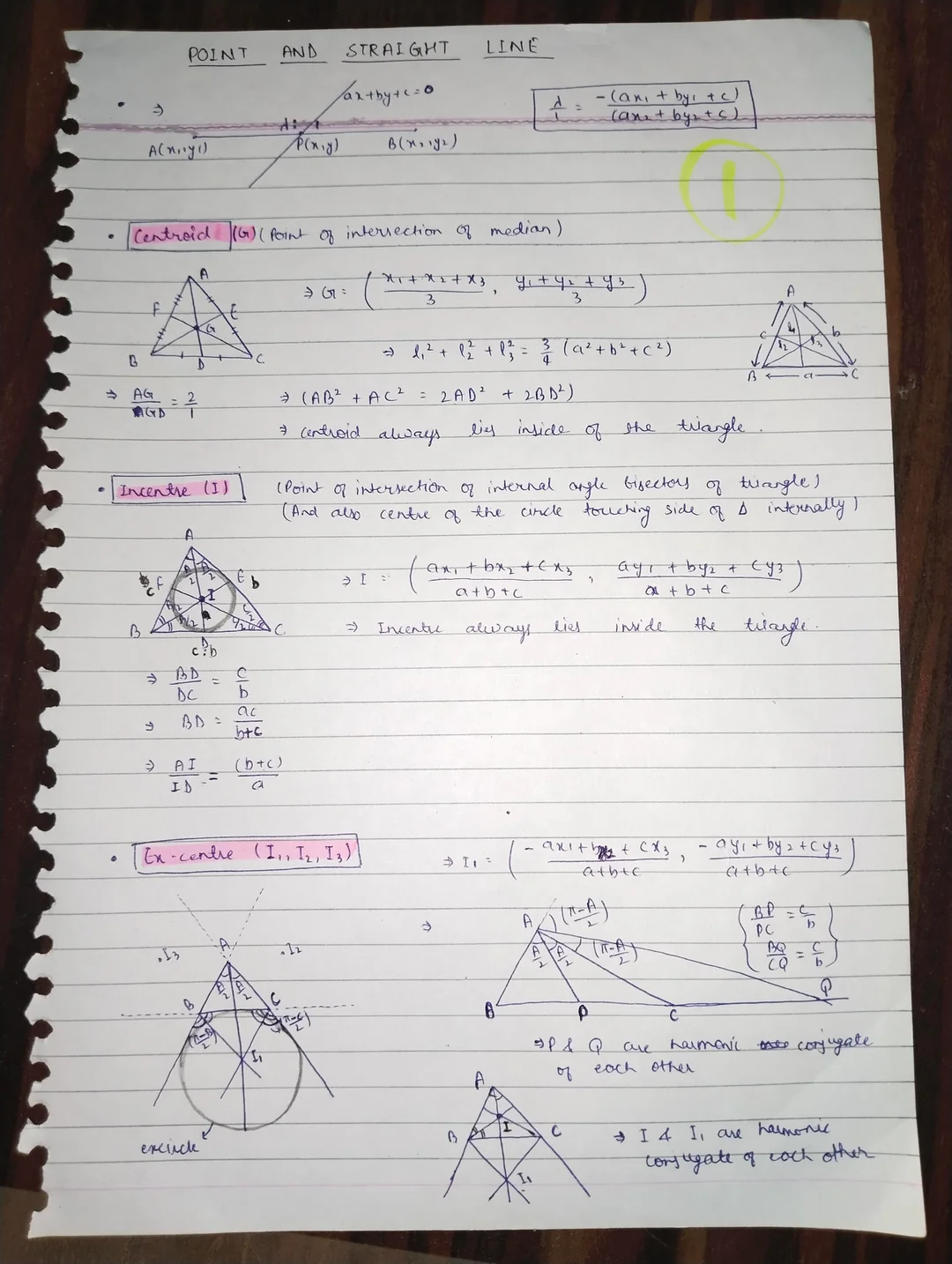
1. Mathematics: The “Formula Diary”
Do not write questions in your notes. Questions are for practice. Your notes should only contain:
-
Formulas: (e.g., $Area = \pi r^2$)
-
Trap Conditions: (e.g., “Warning: In Compound Interest, if interest is ‘Quarterly’, divide rate by 4”)
-
Tricks: Specific short tricks for specific patterns.
Pro Tip: Buy a small, pocket-sized diary. Write all geometry theorems in it. Carry it in your pocket and read it while traveling.
2. General Knowledge (GS): Mind Maps
History is a timeline. Geography is a map.
Instead of writing “Ashoka did this, then he did that,” draw a Flowchart.
-
Chandragupta -> Bindusara -> Ashoka -> Kalinga War (261 BC) -> Buddhism.
One flowchart can replace 2 pages of text. Your brain remembers images better than words.
3. Current Affairs: The Controversial Truth
Stop making daily Current Affairs notes.
I repeat: STOP.
Writing daily news takes 1 hour. In 30 days, that is 30 hours.
Instead, download a Monthly PDF (from reliable sources like Adda247 or StudyIQ) at the end of the month. Highlight it. It takes 3 hours.
You just saved 27 hours. Use that time for Maths.
Digital Notes vs. Paper Notes: The Verdict
In 2025, many students use iPads or Notion.1
-
Digital (iPad/Laptop): Good for storing PDFs and screenshots. Bad for memory. You don’t “feel” the writing.
-
Paper (Handwritten): Best for memory. The act of writing with a pen helps retention.
My Advice: Stick to pen and paper for your core subjects (Maths, Grammar). Use digital folders only for saving PDFs and Previous Year Papers.
When to Throw Your Notes Away
Your notes should shrink over time.
-
Month 1: You have 100 pages of History notes.
-
Month 3: You have memorized 80% of it. Now, re-write the remaining 20% (the hard facts) onto 10 pages. Throw the old notes away.
-
Exam Week: You should have only 5 sheets of paper containing the most difficult data.
This is the “Funnel Technique.” If your notes are getting thicker, you are doing it wrong.
Conclusion
Notes are not a book you write for others; they are a cheat sheet you write for your future self.
If your notes look messy, scratched out, and colorful—Good. It means you are actually using them.
Start a “Formula Diary” for Maths today. It will be your best friend in the exam hall queue.
Need to know which books are worth making notes from? Check our review on Speedy vs. Lucent for Railway Exams.