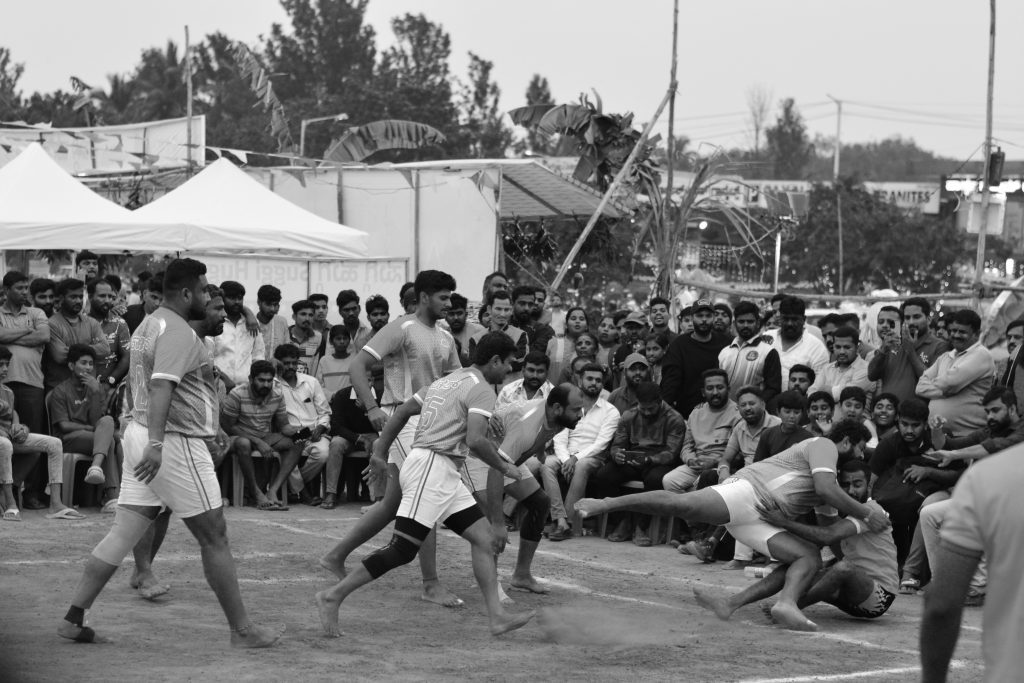
Kabaddi is simple enough to start watching quickly and tactical enough to reward close attention. Once you understand raids, tackles, points and the role of the midline, professional matches become much easier to follow.
What Kabaddi Actually Is — For Those Who Have Never Watched
Kabaddi is a contact team sport played between two teams of seven players on a rectangular court divided by a centre line. The basic premise is simple to grasp. One player from the attacking team — called the raider — crosses the centre line into the opposing team’s half with the goal of tagging (touching) as many defenders as possible and returning to their own half safely.
The crucial constraint: the raider must do all of this on a single breath — continuously chanting “kabaddi kabaddi kabaddi” as proof that they are not breathing, a rule enforced in traditional kabaddi that modern professional versions have adapted. If the raider tags defenders and returns home, those defenders are out and points are scored. If the defending team catches and holds the raider until their breath runs out, the raider is out.
The defending team’s job — through a combination of tackles, blocks, and coordinated holding — is to prevent the raider from returning. The most celebrated defensive play is the chain tackle — where multiple defenders coordinate to trap a raider who has tagged one of them, making escape impossible.
What makes kabaddi spectacularly watchable at the elite level is the combination of athleticism and improvisation involved. Elite raiders have a repertoire of escape techniques — the hand touch, the toe touch, the bonus point dash — that they deploy in split-second response to defender positioning. Elite defenders read raider movements and coordinate tackles with the kind of non-verbal communication that only comes from years of practice together.
Pro Kabaddi League: How It Transformed the Sport
The Pro Kabaddi League launched in 2014 with eight teams and a broadcast deal with Star Sports. By 2015, it had become the second most watched sports league in India by viewership — behind only IPL. By 2017, the PKL auction was generating player transfers worth crores of rupees for players who had never previously earned significant professional income from the sport.
The PKL model deliberately borrowed from the IPL playbook — franchise teams representing Indian cities, an auction system for players, prime-time broadcast slots, and aggressive marketing of individual player personalities alongside team identities. The formula worked spectacularly.
Teams currently competing in the Pro Kabaddi League:
Jaipur Pink Panthers — The inaugural PKL champions in 2014, owned by actor Abhishek Bachchan. Winners of three PKL titles. Known for their aggressive raiding style.
Patna Pirates — Three-time consecutive PKL champions between 2015 and 2017 — a record of sustained dominance that has not been matched since. Their Pardeep Narwal, during his peak seasons with Patna, was the highest-scoring raider in PKL history and arguably the most recognised player the sport has produced.
U Mumba — One of the original franchises and perennial playoff contenders. Owned by the Unilazer group and known for strong defensive squads.
Bengaluru Bulls — One-time PKL champions with a passionate Bengaluru fan base.
Dabang Delhi KC — PKL champions in Season 8. One of the most well-managed franchises in terms of squad building.
Tamil Thalaivas, Bengal Warriors, Gujarat Giants, Puneri Paltan, Haryana Steelers, Telugu Titans, and UP Yoddhas make up the rest of the current PKL franchise landscape, with the league having expanded from the original eight teams.
The Athletes: What Elite Kabaddi Players Actually Do
Understanding the physical demands of elite kabaddi makes watching it more impressive. A starting seven in PKL includes specialised roles:
Raiders — The most celebrated and highest-paid players. Elite raiders need explosive acceleration over 2 to 4 metres, exceptional body control and flexibility (toe touches and frog jumps require near-gymnastic flexibility), the ability to read defensive formations instantly and change direction at full speed, and extraordinary composure under the physical and psychological pressure of being surrounded by defenders trying to hold them.
Defenders — Corners and Cover Players — Corners are the primary tacklers, positioned at the outer edges of the defensive line. They need raw strength, excellent tackling technique, and the ability to hold an elite raider who is writhing, spinning, and using full body weight to escape. Cover players in the middle of the defensive line read the raider’s direction and plug gaps.
All-rounders — Players who raid and defend effectively, providing tactical flexibility to their captains.
The physical profile of an elite PKL player is distinct from almost any other sport: typically compact and powerful, with muscular legs and core, exceptional flexibility in hips and hamstrings, and anaerobic fitness that allows explosive effort repeated across 40 minutes of play.
Kabaddi at the International Level
Kabaddi has been part of the Asian Games since 1990 and India has won every men’s gold medal in Asian Games kabaddi competition in that time — a remarkable record of dominance that reflects both the depth of Indian kabaddi talent and the sport’s cultural roots in the subcontinent.
The Kabaddi World Cup has been held irregularly since 2004, with India winning every edition of the men’s tournament. Iran has been the most consistent challenger to India’s dominance at international level, with their PKL-experienced players increasingly competitive against Indian national squads.
Women’s kabaddi at the international level has also grown significantly — India has similarly dominated the women’s Asian Games competition, and the sport’s grassroots presence in rural and semi-urban India means the talent pipeline remains deep.
Why Kabaddi Deserves More Attention Than It Gets
Despite PKL’s commercial success and large television viewership, kabaddi does not receive the same media coverage, sponsorship attention, or cultural prestige as cricket in India. This gap is partly structural — cricket’s head start of over a century in organised professional competition means it has embedded itself in Indian culture in ways no other sport has matched — but it is also partly a self-fulfilling prophecy.
The players who compete in PKL are extraordinary athletes performing at the limits of human agility, strength, and tactical intelligence. The matches are genuinely unpredictable — leads can evaporate in two or three raids, and teams can recover from seemingly hopeless positions through a single coordinated defensive surge. The crowd atmosphere at PKL venues rivals the intensity of IPL matches.
For anyone who has not watched a PKL match, Season 5 is widely recommended as the entry point — the quality of play, the range of personality and storylines, and the broadcast production had all reached maturity by that season. Available on the JioHotstar platform.
A Final Word
Kabaddi is the sport that India invented for itself over centuries and then almost allowed to become a footnote in its own country’s sporting culture. PKL has reversed that trajectory meaningfully — creating professional careers for athletes from backgrounds that would never have intersected with the financial rewards of sport, building urban fan bases for a game that was previously seen as rural and regional, and putting Indian-origin sport on an international stage.
It deserves your attention. Give it one match. The chances are high that it will hold it.
Sources and verification
For factual or time-sensitive points, start with primary or official sources:
Links are provided for verification; external pages can change after this article is updated.
Continue on ppdv.in

Alen edits ppdv.in and writes practical guides for readers in India. Articles use published sources where factual accuracy matters and are updated when important information changes.